
You walk into a professional event with 300 people in the room. Somewhere in that crowd are three or four people who could genuinely change the trajectory of your business. The problem is, you don’t know who they are, and they don’t know you exist.
For anyone investing time in trade shows, conferences, and industry events, the value comes down to the quality of connections made. One meaningful conversation with the right person can be worth more than a hundred business cards collected at random. But most event networking is left to chance. You wander the floor, make small talk, hope you stumble into the right conversations. We wanted to fix that.
Think about the ROI of a typical conference. Between the ticket, travel, accommodation, and the days out of the office, a single event can easily cost thousands. Yet most professionals leave with a handful of business cards, half of which they’ll never follow up on, and a vague sense that it was “good.” That’s not a return on investment. That’s an expensive gamble.
BlaBlaNote turns event networking from a gamble into a strategy.
Matchmaking before the event starts
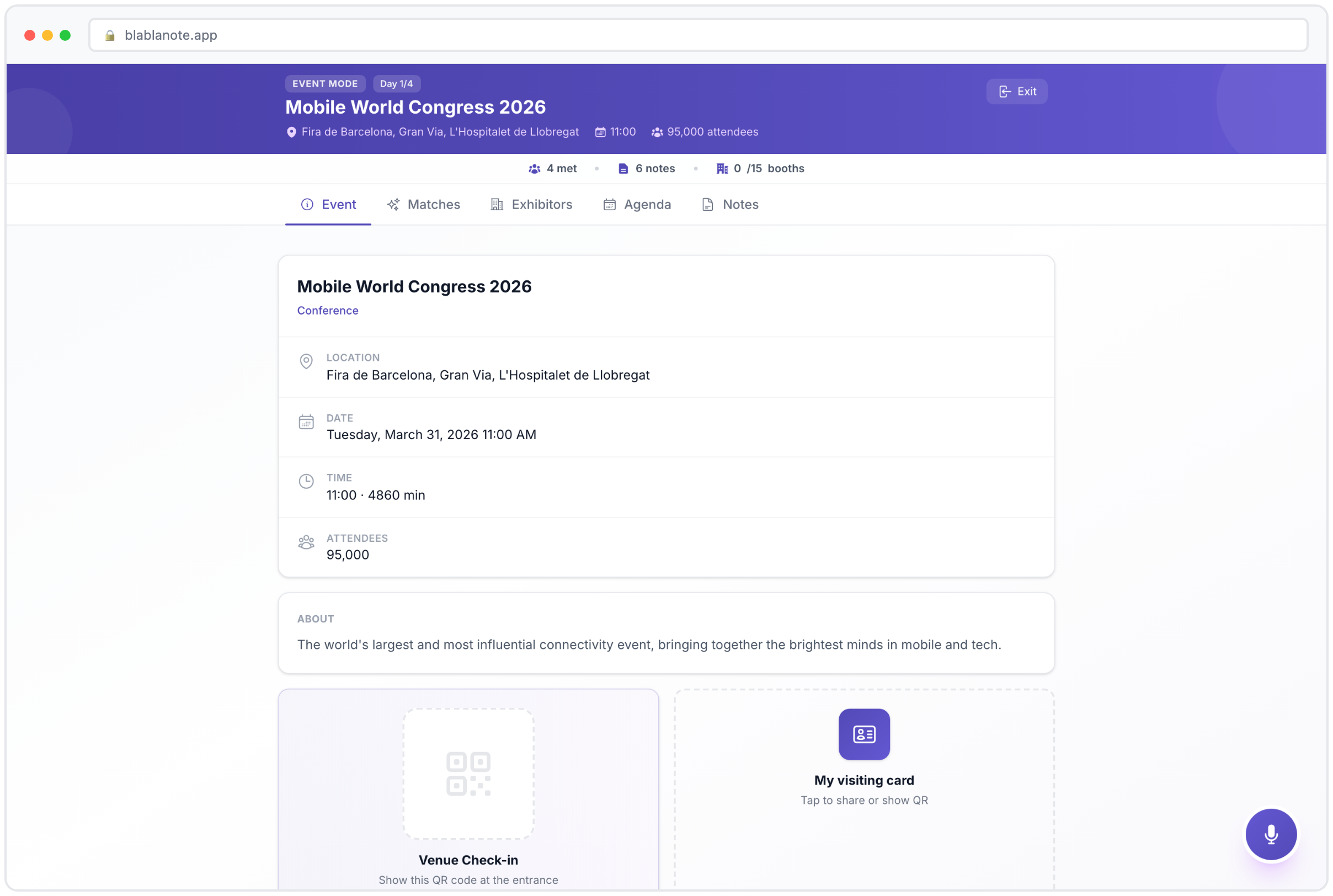
When you join an event on BlaBlaNote, you tell us what you’re looking for: potential partners, investors, clients in a specific industry, people working on a particular problem. The AI cross-references your profile and goals with every other attendee and surfaces the most relevant matches.
You can review profiles, read backgrounds, and plan who to approach before you even leave your office. No more wandering the venue hoping serendipity does its job.
How the matching works
The matchmaking algorithm considers several factors to produce relevant results:
Your profile. What you do, your industry, your experience, your company. If you’ve imported your LinkedIn data, the AI has a richer picture to work with. The more complete your profile, the better the matching quality.
Your stated goals. Before each event, you specify what you’re looking for. This could be specific (“I want to meet Series A investors in healthtech”) or broad (“I’m looking for potential technology partners”). The AI uses these goals to weight the matching in the right direction.
Attendee profiles. Every other attendee who has registered through BlaBlaNote has a profile and stated goals too. The AI looks for complementary patterns. An investor looking for healthtech startups gets matched with healthtech founders. A company looking for a new agency gets matched with agencies that specialize in their industry.
Existing connections. If any attendees are already in your BlaBlaNote contacts (from a previous import or from past interactions), the system flags them. This means you can plan to reconnect with existing contacts at the event, not just meet new people.
The result is a prioritized list of people to meet, with context for each one: who they are, why the AI thinks you should connect, and what you might discuss. This transforms event preparation from “look at the attendee list and hope for the best” to “I know exactly who I’m looking for and why.”
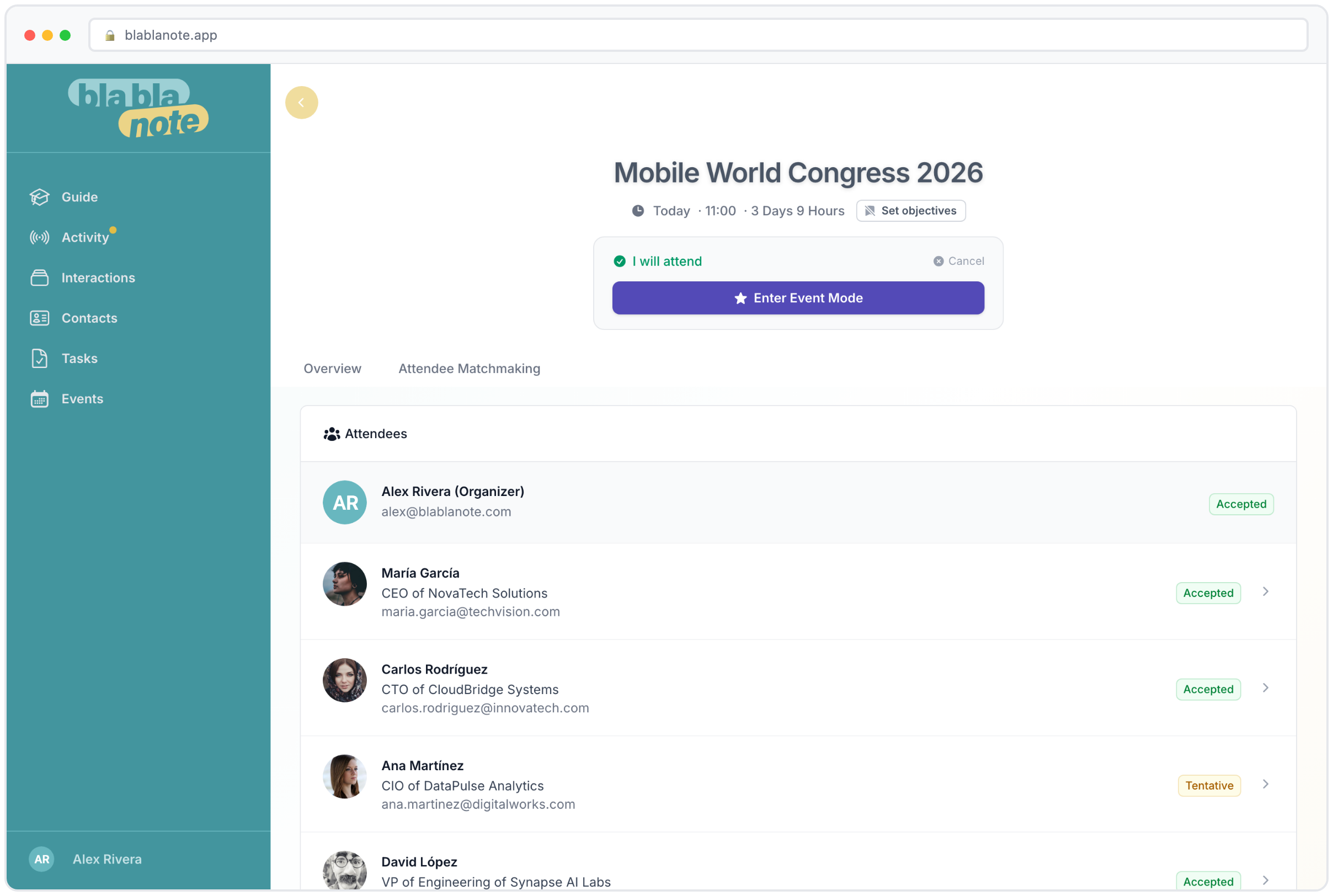
Team coordination
For a team sending three people to an industry conference, this means each person arrives with a targeted list of who to talk to, maximizing the team’s coverage and making the most of the event. The lists can be coordinated so team members don’t overlap. Person A focuses on potential clients, Person B on partnership opportunities, Person C on industry thought leaders. Everyone has clear targets and the context to make each conversation count.
Before the event, the team can review their combined matches and align on strategy. “I see you’re matched with the CTO of Company X. I have an existing relationship with their VP of Sales. Let me introduce you.” This kind of coordination turns three individuals at a conference into a coordinated networking team.
During the event
Your matches and attendee insights are on your phone. When you have a great conversation, you can capture notes right there on the spot (or call them in later on your way to the next session). Everything gets linked to the contact automatically.
Capturing in the moment
This is where most event tools fall short. They help you find people, but they don’t help you remember what was said. BlaBlaNote captures the substance of each encounter, not just the name and company, so when you sit down to write follow-up emails the next day, you have real context to work with instead of vague memories.
Here’s a practical workflow for event networking with BlaBlaNote:
-
Before approaching someone, pull up their profile on your phone. Review the AI’s match reasoning and any existing context you have. You walk into the conversation knowing something about them.
-
During the conversation, be present. Don’t take notes on your phone while talking, that’s rude and counterproductive. Focus on listening and engaging.
-
Right after the conversation, step aside and capture your notes. You have several options: record a voice note in the app, send a voice message via WhatsApp or Telegram, or call BlaBlaNote’s number and speak your notes. Thirty seconds is usually enough for the key points.
-
The AI processes your note and extracts the key points: what you discussed, what they’re interested in, any commitments or next steps, and the overall tone of the interaction. This becomes part of the contact’s profile.
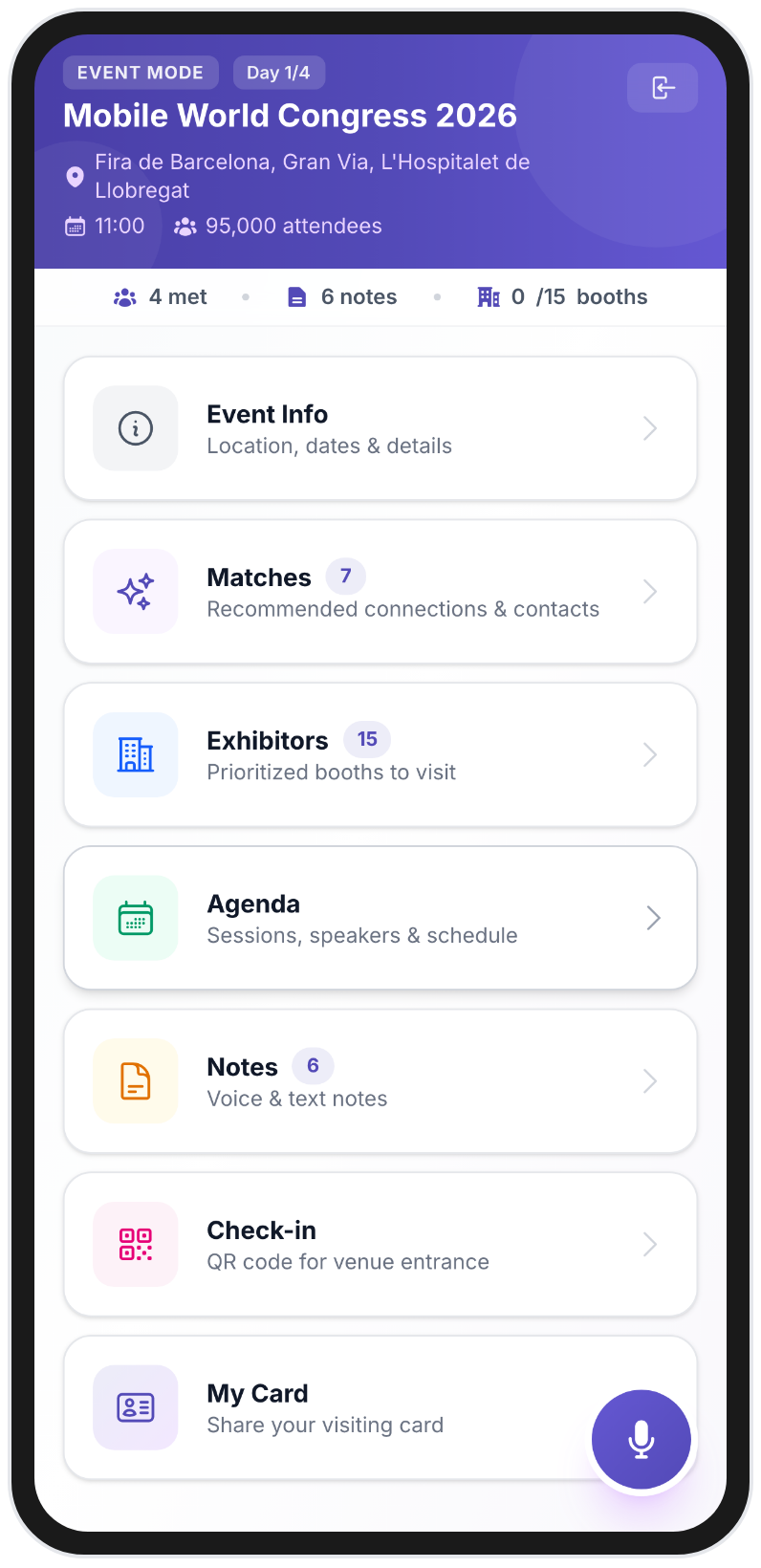
By the end of a full day of event networking, you might have captured notes on fifteen conversations. Each one is transcribed, summarized, and linked to the right contact. Compare this to the alternative: a stack of business cards in your pocket with hastily scribbled notes on the back (if you remembered to write anything at all).
Scanning digital business cards
If you use a BlaBlaNote digital business card, events are where it shines. When you meet someone and want to exchange details, pull up your QR code and let them scan it. Your information flows directly into their phone. No physical cards to carry, no “I’ll send you my details” that gets forgotten.
If the other person also uses BlaBlaNote, the exchange is even smoother. Both contacts are automatically created in each other’s systems, linked to the event, and ready for post-event follow-up.
After the event
This is where most networking falls apart. You collected a stack of business cards, had some good chats, maybe connected on LinkedIn. Then Monday happens, and the follow-ups never get sent. The research shows that the window for effective post-event follow-up is 48 hours. After that, the connection goes cold fast.
BlaBlaNote sends you post-event prompts. Who did you meet? How did it go? What’s the next step? Your conversation notes are already attached to each contact, and follow-up reminders are set automatically.
The 48-hour follow-up window
The post-event period is where the real value of BlaBlaNote’s event networking becomes clear. Here’s what a typical post-event workflow looks like:
Day 1 (the day after the event). You open BlaBlaNote and see all the contacts you met at the event, each with your conversation notes attached. The system prompts you to review each one and set a follow-up cadence. For the most promising connections, you write a personalized follow-up email or message. You can reference specific things you discussed because the AI extracted the key points from your voice notes.
Day 2-3. You send the remaining follow-ups. For contacts who are already in your network, the interaction gets added to their timeline. For new contacts, the event encounter becomes the first entry in what you hope will be a long relationship history.
Week 1-2. Some of those follow-ups turn into meetings. When they do, BlaBlaNote is ready with meeting preparation that includes the full context of your event encounter. You walk into the first real meeting already knowing the backstory.
The people you met become real contacts in your network, with context and a plan, not just names you vaguely remember. Follow-up cadences ensure the connections you made don’t fade. The event was not the end of the networking process; it was the beginning.
Measuring event ROI
Over time, BlaBlaNote gives you data on the actual outcomes of your event networking. How many contacts from a specific event turned into active relationships? How many led to meetings, partnerships, or deals? This data helps you decide which events to attend in the future and how to approach them. Instead of relying on gut feeling, “that conference was pretty good,” you have concrete metrics on the value generated.
Getting in is easy
Event organizers invite attendees directly through BlaBlaNote. You receive an invitation, register, and you’re in the event dashboard with your matches ready. Quick setup, no friction. For event organizers themselves, BlaBlaNote becomes a value-add for attendees, turning “networking opportunities” from a vague promise into a structured, measurable experience.
For event organizers
If you organize professional events, BlaBlaNote’s event networking feature is a powerful differentiator. Instead of simply telling attendees “there will be networking opportunities,” you can offer AI-powered matchmaking as part of the event experience. Attendees arrive with targeted connection lists. They leave with documented conversations and follow-up plans. The perceived value of your event increases because the connections made actually lead somewhere.
Organizers also get aggregate insights (anonymized) on networking activity: how many matches were made, how many conversations happened, how active attendees were in the networking features. This data helps you design better events and demonstrate value to sponsors.
Making the most of every event
We’ve seen this workflow transform how people approach professional events. Instead of coming home with a pile of unorganized cards and fading memories, teams come home with enriched contacts, conversation notes, and a follow-up plan already in motion. The connections made actually lead somewhere, because genuine follow-through is how relationships begin.
The professionals who get the most from events are the ones who treat networking as a process, not a moment. The event itself is just the middle chapter. Preparation, facilitated by AI matchmaking and your existing contact intelligence, is the first chapter. Follow-up, powered by conversation notes and automated reminders, is the last chapter and often the most important one.
With BlaBlaNote, every chapter is supported by the right tools. You prepare with data, connect with intention, capture what matters, and follow through with context. That’s how you turn a room full of strangers into a network of meaningful professional relationships.