
Every alumni association and professional network has the same asset and the same problem. The asset is a few thousand people who already have a reason to trust each other. The problem is that they never meet.
The usual attempts are a directory nobody opens, a WhatsApp group that becomes noise within a month, and an annual dinner where you talk to the four people you already knew.
We’ve spent the last two months building the third option, and it’s now live: continuous mode, BlaBlaNote’s networking engine running permanently for a community instead of for the two days of a conference.
The shape of it
A community using BlaBlaNote doesn’t get a forum. It gets a rhythm.
On the first of each month, members who don’t already have someone waiting receive a newsletter with up to three recommended members: who they are, and why the two of them are being put in front of each other. Not a random draw, and not “people you may know.” The reasons are the actual fit the matching engine computed, written out in plain language.
The member opens the app, reads the expanded profile of each one, and answers a single question per person: do you want to meet them, yes or no?
That’s the whole interaction. It takes a minute a month.
Say yes to several, then rank them
If you say yes to more than one, you order your queue from the “My introductions” tab, and the list marks how far this cycle’s quota reaches, so the question is concrete: which of these go through next.
We deliberately don’t ask you to rank inside the deck. In the deck you see one profile at a time, so at the moment of saying yes there’s no set to compare against, and asking “how much does this one matter?” about a single card gets you the default answer or everything marked high. With the queue in front of you the comparison is relative, which is the kind of judgment people are actually good at.
Everything else about the queue follows from that:
- Quota is consumed by introductions that actually happen, not by recommendations sent and not by requests made. A month where nobody said yes back doesn’t cost you anything.
- A confirmed match above this month’s quota isn’t lost, it’s queued, and you’re told you have one waiting.
- The queue takes priority over discovery. While you have people waiting, you get them instead of new profiles. You can explicitly ask for new profiles anyway, or move up a plan.
- Until you order it, the queue runs oldest first. And a match that arrives after you’ve ordered it goes to the back, it doesn’t jump the arrangement you made.
Saying no, without it being awkward
You can decline without giving a reason. The quick pass in the deck is exactly that: a no, with nothing attached, and the pair stays recommendable in future.
If you do want to say why, there are eight reasons: already know them, wrong sector, different goals, wrong context, bad timing, incomplete profile, not interested, other.
Only one of those, not interested, permanently removes the pair. The other seven are read as preference signal and leave that person recommendable later, because “bad timing” in March is not “no” in November. There’s also an explicit never recommend this person to me again checkbox, which works regardless of which reason you picked, or whether you picked one at all.
Unanswered requests age out gently
A request you never answer doesn’t expire on a clock. It ages one step per monthly pass, loses priority, and after three passes it’s archived.
The pass before it’s archived warns the person who hasn’t replied, so nobody loses a request without a last nudge. And people who consistently don’t answer get recommended a little less over time, gradually, rather than being cut off.
Every introduction has a thread
Each introduction now carries a two-way chat underneath it, in “My introductions.” Not a group, not a channel: a conversation between exactly the two people being introduced, so that coordinating doesn’t have to happen over email addresses neither of you wanted to hand over yet.
The first message in the thread is the invitation text itself. Introductions made before chat existed have one too: their original “why you two” was converted into message number one, already marked as read, so nobody woke up to months of retroactive notifications.
What continuous mode does not do yet
We’d rather list this than have you find out:
- A meeting scheduled in community mode doesn’t write back to your personal CRM. At events it does. Here it doesn’t, yet.
- There’s no calendar file, no reminder, and no automatic “did you meet?” prompt. You confirm from “My introductions,” but nothing pings you at the appointed hour.
- The cadence is fixed for everyone. Monthly, three profiles. Communities can set their own quota of introductions, but not their own rhythm. That’s on the roadmap.
- Times are proposed by hand. In community mode there’s no pre-filled slot suggestion, and no connected calendar is consulted anywhere in BlaBlaNote’s networking today.
For the organizer
If you run a community, the parts you control are the quota of introductions per plan, membership verification, and whether cold introductions are enabled: a premium option letting a member ask to meet someone they weren’t mutually recommended to. Cold-reached profiles are marked as such in the deck, so the initiative reads as deliberate. It needs both switches on: enabled for the community by us, and a Premium plan on the member’s side.
One rule doesn’t have a switch, and won’t: there is no automatic connection. However strong the mutual interest the engine computes, somebody always has to ask and somebody always has to accept.
Joining one
Membership is verified before anything else happens, either automatically through an institutional email domain or manually by the community. Verified membership is the entire premise: the reason a stranger from your alumni network is worth a conversation is that they’re genuinely from your alumni network.
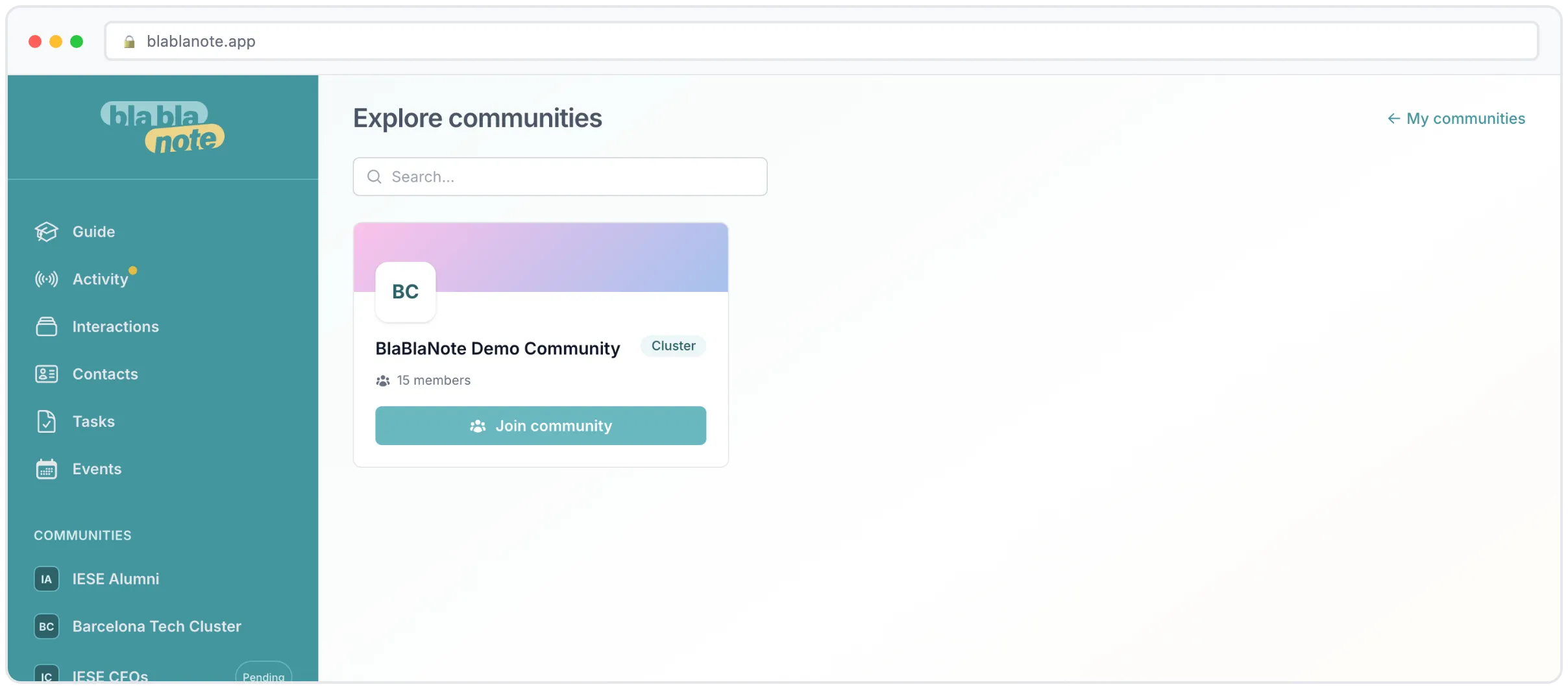
Members get a personal CRM alongside it, so the introductions you make actually land somewhere. On the higher plans that CRM includes the AI features: meeting capture, calendar sync, the lot.
If you’re a member of a community that’s already running on BlaBlaNote, you’ll get the newsletter on the first of the month. If you run one and this sounds like the thing you’ve been trying to do with a spreadsheet and good intentions, the details and the plans are at blablanote.community.
And if you just want the CRM part for yourself, that’s still here and always was.
