
- Define what you’re after
- Getting specific pays off
- How your goals work for you
- Smarter event networking
- Prioritized weekly planning
- Better conversation context
- Smarter contact management
- The before and after
- For teams
- Coordinated coverage at events
- Organizational intelligence
- Practical tips for setting your strategy
- It takes five minutes
Networking without a goal is just socializing. There’s nothing wrong with socializing, but if you’re investing time in professional events, conferences, and relationship building, you probably want something more than pleasant conversations that lead nowhere.
Most professionals have a vague sense of what they’re looking for. “I want to meet more people in my industry.” “I need to find clients.” “I should expand my network.” The problem with vague goals is that they lead to vague outcomes. You attend an event, meet interesting people, come home, and realize you didn’t move the needle on anything specific.
Think about the last conference you attended. You probably had a dozen conversations, collected a handful of business cards or LinkedIn connections, and then… nothing happened. Not because the people weren’t interesting or the event wasn’t good, but because you didn’t have a framework for deciding which relationships to invest in and why. Without that framework, every conversation feels equally important, which means none of them get the focused follow-up they deserve.
BlaBlaNote’s Networking Strategy helps you turn that vague sense into something actionable. It’s not a personality test or a strategic planning exercise. It’s a practical configuration that tells the AI what you’re working toward, so every recommendation, every match, and every suggestion moves you closer to your professional objectives.
Define what you’re after
When you set up your networking strategy, you choose a primary goal. The options cover the most common professional networking scenarios:
- Grow your career by finding mentors, increasing visibility, and uncovering new opportunities
- Build business by connecting with potential clients, partners, or investors
- Learn and connect by discovering best practices, industry trends, and thought leaders
- Define your own custom goal if none of the above fit your situation
Then you get specific. What kind of collaborations are you open to? What expertise can you offer others? What kind of support would be most valuable to you? What values guide how you work? These aren’t abstract exercises. They’re inputs that the AI uses to power concrete features.
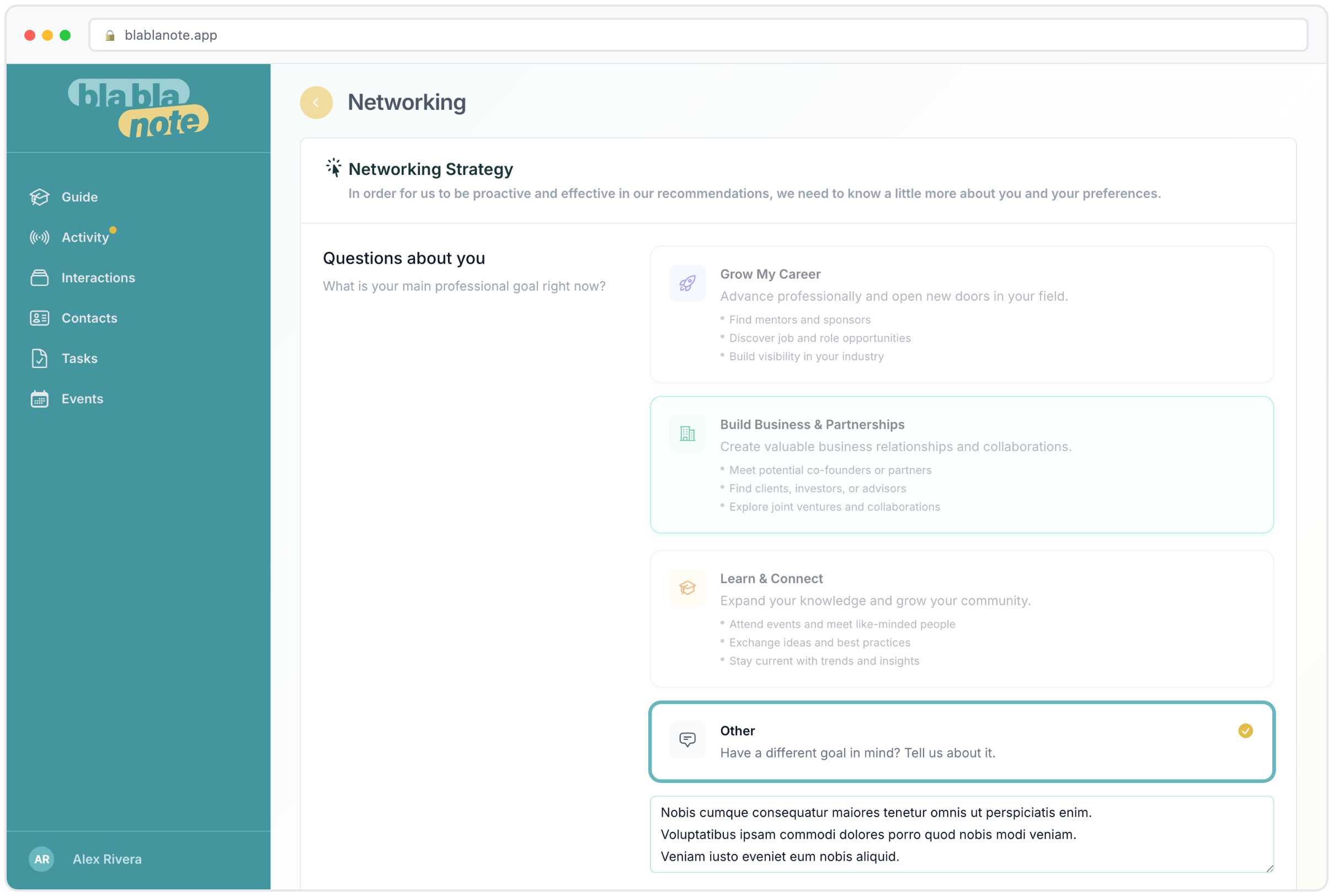
For example, if you’re a consultant who specializes in supply chain optimization and you’re looking for partnerships with technology vendors, that’s very different from a startup founder who’s looking for seed funding and early adopters. The conversations you should prioritize, the people you should seek out at events, and the follow-ups that matter most are completely different in each scenario. Your networking strategy captures that difference and makes it operational.
Getting specific pays off
The more detail you provide, the sharper the AI’s recommendations become. Saying “I want to find clients” gives the system something to work with. But saying “I’m looking for mid-market SaaS companies that need help with customer retention strategy, and I can offer workshop-based engagements” gives it a precise filter to apply across every interaction.
Think of it like briefing an incredibly well-connected assistant. If you tell them “introduce me to interesting people,” they’ll do their best, but the results will be scattered. If you tell them exactly what you’re looking for, they can scan a room of 500 people and point you to the five who matter most. That’s what your networking strategy does for BlaBlaNote’s AI.
How your goals work for you
Once your strategy is defined, it shapes how BlaBlaNote operates across the entire platform. This isn’t a feature that lives in one corner of the app. It’s a foundation that influences every AI-powered recommendation you receive.
Smarter event networking
At professional events, your goals drive the matchmaking algorithm. Instead of generic “you might like this person” suggestions, the AI recommends attendees whose objectives complement yours. Someone looking for technical expertise gets matched with someone who offers it. Someone seeking partnerships gets matched with people building complementary products.
The event features, optimized agenda, exhibitor prioritization, and attendee matchmaking, all use your strategy as the foundation. If you haven’t set event-specific objectives, your networking strategy acts as the fallback, ensuring the AI always has something meaningful to work with.
This means you can walk into a conference with a clear plan. Instead of wandering the floor hoping to bump into the right people, you arrive knowing which sessions to attend, which exhibitors to visit, and which attendees to seek out. The AI has already done the matching work. You just need to show up and have the conversations.
Prioritized weekly planning
Your weekly planning email also uses your strategy. Reconnection suggestions prioritize contacts aligned with your goals. Follow-up recommendations factor in what you’re trying to achieve, not just how long it’s been since you last spoke.
If your goal is business development, the weekly email will surface dormant contacts who work at companies that match your target profile. If your goal is career growth, it will remind you to reconnect with mentors and industry leaders who can open doors. The same contact database, filtered through a different lens, produces completely different action items.
Better conversation context
When you use BlaBlaNote to prepare for meetings, your networking strategy adds another layer of context. The AI doesn’t just tell you what you discussed last time. It frames the relationship in terms of your goals. “You discussed partnership possibilities with Maria. This aligns with your goal of building technology vendor relationships. Consider following up on the integration proposal she mentioned.”
This kind of goal-aware context turns a simple meeting prep into a strategic briefing. You walk in knowing not just the history, but the opportunity.
Smarter contact management
Your contact management becomes more intentional too. When you add someone new to your network, whether through the browser extension, a LinkedIn import, or a manual entry, the AI can flag when a new contact aligns with your strategic goals. Over time, this helps you see patterns in your network: where it’s strong, where it has gaps, and who might help you fill them.
The before and after
Before setting a networking strategy, BlaBlaNote is already a powerful tool. It tracks your contacts, records your conversations, extracts tasks, and keeps your relationships organized. But the AI treats every relationship with equal weight. A casual acquaintance gets the same follow-up suggestion as a key potential client.
After setting a networking strategy, the AI understands priority. Not every contact is equally important to your current objectives, and the system reflects that. Your weekly email leads with the contacts that matter most. Event recommendations focus on people who can actually help you achieve your goals. Follow-up suggestions are weighted by strategic relevance, not just recency.
This doesn’t mean BlaBlaNote ignores your other contacts. It means the AI has a hierarchy to work with, and the most goal-aligned relationships float to the top of every recommendation list.
For teams
When every team member defines their networking strategy, the organization gets a clearer picture of collective goals. A team focused on growing client relationships gets different AI recommendations than a product team looking for technical partnerships. The tool adapts to the person, not the other way around.
For companies investing in event attendance, networking strategies ensure every person on the floor has a focused agenda. No more “let’s see who we run into.” Instead, each team member arrives knowing who to meet and why, aligned with both their personal goals and the company’s objectives.
Coordinated coverage at events
Imagine sending five people to a major industry conference. Without networking strategies, they’ll probably attend the same popular sessions, talk to the same obvious contacts, and come back with overlapping notes. With individual strategies defined, the AI can distribute recommendations across the team. The sales lead gets matched with prospects. The product manager gets matched with technical partners. The CEO gets matched with investors and press. Same event, five times the coverage.
Organizational intelligence
Over time, the networking strategies across your team create a map of what the organization is collectively looking for. This helps leadership understand where to invest in relationship building and where existing connections already exist. It turns networking from an individual activity into a team sport with visible outcomes.
Practical tips for setting your strategy
Start with your next 90 days. Don’t try to capture your entire career ambition. Focus on what you’re actively working toward right now. Looking for three new clients this quarter? That’s your goal. Trying to hire a senior engineer? That’s your goal. Keep it current and specific.
Revisit quarterly. Your professional objectives shift. Maybe you closed those three clients and now you’re focused on delivery. Maybe you filled the engineering role and now you’re thinking about strategic partnerships. Update your strategy and the AI recalibrates everything downstream.
Be honest about what you offer. The matchmaking works best when both sides are specified. Don’t just describe what you need. Describe what you bring to the table. Great networking is mutual, and the AI can make better matches when it knows both sides of the equation.
Use your networking strategy alongside event-specific goals. When you attend a specific event, you can set event-specific objectives that layer on top of your general strategy. This gives the AI the most to work with: your broad professional goals plus your specific agenda for this event.
It takes five minutes
Setting your networking strategy isn’t a big exercise. It’s a quick configuration in your profile settings. Choose your goal, select your preferences, add some detail about what you offer and what you’re looking for, and you’re done. You can update it anytime as your focus shifts. Moving from job-hunting to growing your professional network? Change the strategy and the AI recalibrates everything downstream.
Five minutes of setup translates into weeks of sharper recommendations. Every voice note you record is analyzed with your goals in mind. Every task extracted from a conversation is prioritized against your objectives. Every follow-up suggestion reflects what you’re actually trying to achieve.
The professionals who get the most from their networks are the ones who are intentional about building them. BlaBlaNote doesn’t replace that intentionality. It amplifies it. You bring the strategy. The AI brings the execution. And together, your networking stops being something that happens to you and starts being something you direct.