
- How it works
- Building your vocabulary list
- Why this matters more than general accuracy
- The ripple effect on AI features
- Real examples
- Multi-language transcription
- Why this matters for multilingual professionals
- Tips for maintaining your vocabulary
- Start with your most common errors
- Update as your business evolves
- Share vocabulary lists with your team
- Don’t over-engineer pronunciation hints
- Set it once, benefit everywhere
Every industry has its own language. Acronyms that outsiders wouldn’t recognize. Product names that sound like made-up words. Technical terms that no general-purpose transcription engine has ever encountered. If you work in biotech, fintech, legal, engineering, or any specialized field, you’ve probably watched a transcription tool turn your most important terms into nonsense.
It’s a frustrating experience. You record a meeting where you discuss the “Kairos platform integration with the FHIR API” and the transcript reads “the Cairo’s platform integration with the fire API.” The general words are fine. The ones that actually matter, the product name and the technical standard, are mangled beyond recognition. Now multiply that across every meeting, every call, every voice note, and you’re looking at transcripts that require significant manual cleanup before they’re useful to anyone.
BlaBlaNote’s custom vocabulary fixes that. It’s a simple but powerful feature that lets you teach the transcription engine the words your business actually uses.
How it works
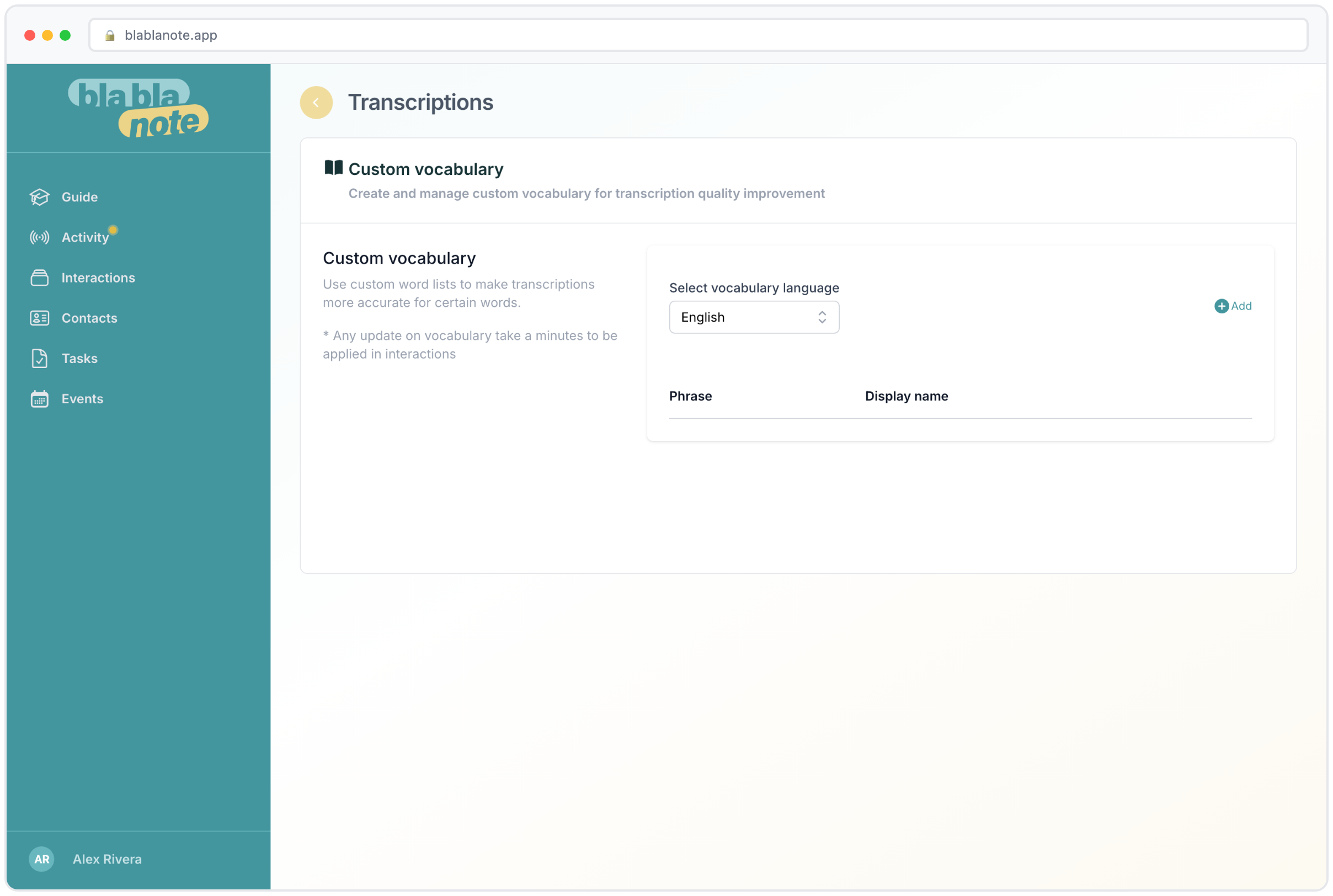
Go to your transcription settings and add the words and phrases that matter to your work. Product names, company names, industry terms, acronyms, proper nouns that get mangled by standard speech-to-text. You can add up to 500 entries, and for tricky pronunciations, you can include hints so the system knows what to listen for.
The process takes just a few minutes. Open your settings, navigate to the vocabulary section, and start typing. Each entry is a word or short phrase, optionally paired with a pronunciation guide. For example, you might add “EBITDA” with the hint “ee-bit-dah” or “Kubernetes” with the hint “koo-ber-net-eez.” The pronunciation hints help when a word’s spelling doesn’t obviously suggest how it sounds.
Building your vocabulary list
Not sure where to start? Think about these categories:
- Your product names and internal code names. These are almost always missed by generic transcription.
- Client and partner company names, especially unusual ones. “Accenture” is probably in the model’s vocabulary. “Xtensio” might not be.
- Industry acronyms. Every field has them: HIPAA, SOC2, MRR, ARR, NPS, OKR. Some are common enough to be recognized. Many are not.
- Technical terms specific to your domain. Medical terminology, legal citations, financial instruments, engineering standards.
- People’s names that come up frequently. If your biggest client is “Rajesh Krishnamurthy” and the transcript keeps writing “Raj Krishma-murthy,” add it.
- Proprietary methodology names. If your firm uses a framework called “The Velocity Method,” that’s not going to be in any standard dictionary.
Once your vocabulary is set, every recording you make, every phone call you capture, every voice message you send benefits from it. The transcription engine prioritizes your custom terms, and the accuracy on the words that actually matter to your business goes up significantly.
Why this matters more than general accuracy
A 95% accurate transcription sounds great until you realize the 5% it gets wrong are your product names and technical terms, exactly the words that carry the most meaning. If “Vertex” becomes “vertex” or “EBITDA” becomes “a bit duh” or your client’s company name is consistently misspelled, the transcript is technically accurate but practically unreliable.
Custom vocabulary solves the long tail problem. General accuracy is already high with modern AI. The gap is in the specialized terms that are unique to your context. Closing that gap is the difference between a transcript you can share with a client and one you need to proofread line by line.
The ripple effect on AI features
Here’s something people don’t always realize: transcription accuracy affects everything downstream. When BlaBlaNote generates AI summaries and key phrases, it works from the transcript. When it extracts tasks and action items from a conversation, it reads the transcript. When it builds context for your meeting preparations, it pulls from past transcripts.
If the transcript says “fire API” instead of “FHIR API,” every downstream feature inherits that error. The summary mentions the wrong technology. The action item references a product that doesn’t exist. The meeting prep context is subtly wrong in a way that could lead to an embarrassing moment with a client.
By improving transcription accuracy at the source, custom vocabulary improves the quality of every AI feature that builds on top of it. It’s a compounding investment. Better transcripts lead to better summaries, better task extraction, better meeting context, and better relationship management overall.
Real examples
A pharmaceutical company adds drug names, clinical trial identifiers, and regulatory body acronyms. Every meeting with the medical team produces clean, accurate transcripts that can go directly into documentation. Terms like “Ozempic,” “Phase IIb,” and “EMA submission” appear correctly every time, eliminating hours of manual correction that used to be required before transcripts could be attached to regulatory files.
A tech startup adds their product name, internal code names, API terminology, and competitor names. Sales call transcripts reference the right tools and features without manual correction. When the team reviews call recordings to improve their pitch, the transcripts accurately reflect which competitors were mentioned and which features were discussed. This feeds directly into their conversation organization and makes it easy to search across months of sales calls for specific technical discussions.
A law firm adds case law citations, Latin legal terms, and statute numbers. Deposition notes and client call summaries use the correct terminology the first time. When an attorney records a voice note after a client meeting, terms like “res judicata,” “27 CFR 555,” and “Chevron deference” appear exactly as they should. The extracted action items reference the correct statutes and rulings.
A coaching organization adds their proprietary framework names, assessment tools, and methodology terms. Session notes reflect the exact language the coaches use with their clients. When a coach records a post-session reflection about a client’s progress through “Stage 3 of the Catalyst Framework,” the transcript preserves the precise terminology that both coach and client understand.
A real estate agency adds property development names, neighborhood abbreviations, and regulatory terms. Listing discussions and client call notes reference the correct developments and zoning classifications. When an agent records a voice note after a property viewing, “the Meridian at Waterfront Phase 2” doesn’t become “the Meridian at Waterfront face 2.”
Multi-language transcription
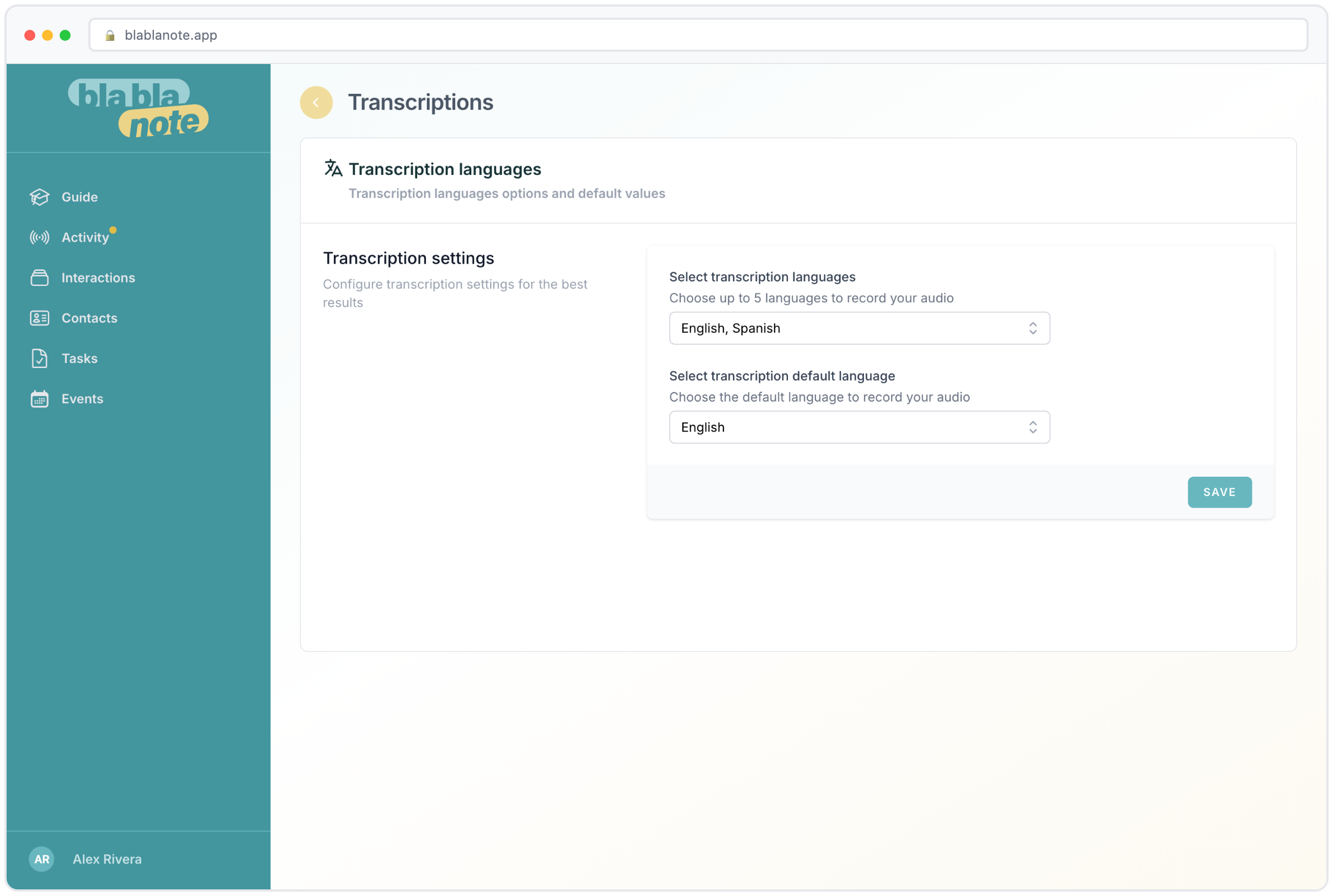
Custom vocabulary works alongside BlaBlaNote’s multi-language support. The transcription engine handles 30+ languages with automatic detection, and it can follow along when you switch languages mid-sentence. Your custom vocabulary is prioritized regardless of which language you’re speaking.
For international teams or professionals who work across markets, this combination means you can have a meeting in Spanish, switch to English for technical terms, and get a clean transcript with your custom vocabulary applied throughout. The AI summaries and key phrases work across all supported languages too.
Why this matters for multilingual professionals
If you’ve ever worked in an environment where meetings flow between two or three languages, you know that technical terms often stay in English regardless of the conversation language. A French investment banker discussing “leveraged buyout” terms in French will still say “LBO” and “EBITDA.” A Japanese software engineer explaining architecture in Japanese will still use “Kubernetes,” “microservices,” and “CI/CD.”
Generic transcription tools often stumble at these language boundaries. They’re either optimized for one language or they treat language switches as errors. BlaBlaNote’s approach, automatic language detection combined with custom vocabulary, handles these transitions naturally. Your custom terms are recognized whether you’re speaking English, Spanish, French, or any of the supported languages.
Tips for maintaining your vocabulary
Start with your most common errors
Before you sit down to build a comprehensive vocabulary list, try this: review your last five or ten transcripts and look for patterns. Which words keep getting wrong? Those are your highest-impact additions. You might find that 80% of your transcription issues come from just 20 or 30 terms.
Update as your business evolves
Your vocabulary isn’t static. New products launch. New clients come on board. New industry terms emerge. Make it a habit to add terms when you notice them being missed. After a meeting with a new client, add their company name and any specific terminology they use. After adopting a new tool or methodology, add those terms too.
Share vocabulary lists with your team
If your organization has a standard set of terms, consider creating a shared reference that team members can use to populate their individual vocabularies. This ensures consistency across the organization. Everyone’s transcripts reference the same product names, client names, and technical terms in the same way.
Don’t over-engineer pronunciation hints
Pronunciation hints are helpful for unusual words, but you don’t need them for every entry. The transcription engine is smart enough to figure out most words from their spelling alone. Save pronunciation hints for words where the spelling is genuinely misleading, like proper nouns from other languages or acronyms that are spoken as words rather than spelled out.
Set it once, benefit everywhere
Your vocabulary applies globally across all your interactions. Add a term once, and it improves every future transcription. You can edit or remove entries anytime as your terminology evolves. It’s a small upfront investment that pays dividends on every recording you make.
Think about the math. If you record just three voice notes or calls per day, that’s roughly 60 transcripts a month. If custom vocabulary saves you even two minutes of proofreading per transcript, that’s two hours a month recovered. Over a year, that’s a full work week you get back, just from adding your industry terms once.
But the real value isn’t in time saved on proofreading. It’s in trust. When your transcripts are accurate, you trust them. You share them with clients. You let the AI build on them. You search through them months later and find exactly what was said. That trust turns BlaBlaNote from a recording tool into a genuine knowledge base for your professional relationships, one where the words that matter most are always captured correctly.