
- What lands in your inbox
- Upcoming meetings with context
- Priority reconnections
- Follow-up reminders
- Dormant connections worth reviving
- Quick wins
- Context changes everything
- How context is built
- A typical Monday with the weekly email
- For managers and team leads
- It works in your language
- Making the most of your weekly email
- The point
Monday morning. Laptop open, coffee in hand, calendar staring at you. There are meetings, but you can’t remember the context for half of them. There are follow-ups you were supposed to send last week. Somewhere in your task list, there’s something urgent that you keep pushing to tomorrow.
For professionals managing client relationships, partnerships, or teams, this Monday chaos isn’t just a personal productivity issue. It’s a relationship risk. A forgotten follow-up means a relationship that fades. An unprepared meeting means someone who feels unimportant. A missed deadline means credibility lost.
Sound familiar? Here’s the thing: the information you need to avoid all of this already exists. Your calendar has the meetings. Your notes have the context. Your contact history has the follow-ups. The problem isn’t missing data. It’s that the data lives in five different places and nobody has time to stitch it all together at 8 AM on a Monday.
We built the weekly planning email to make Mondays feel less like detective work and more like a clear briefing.
What lands in your inbox
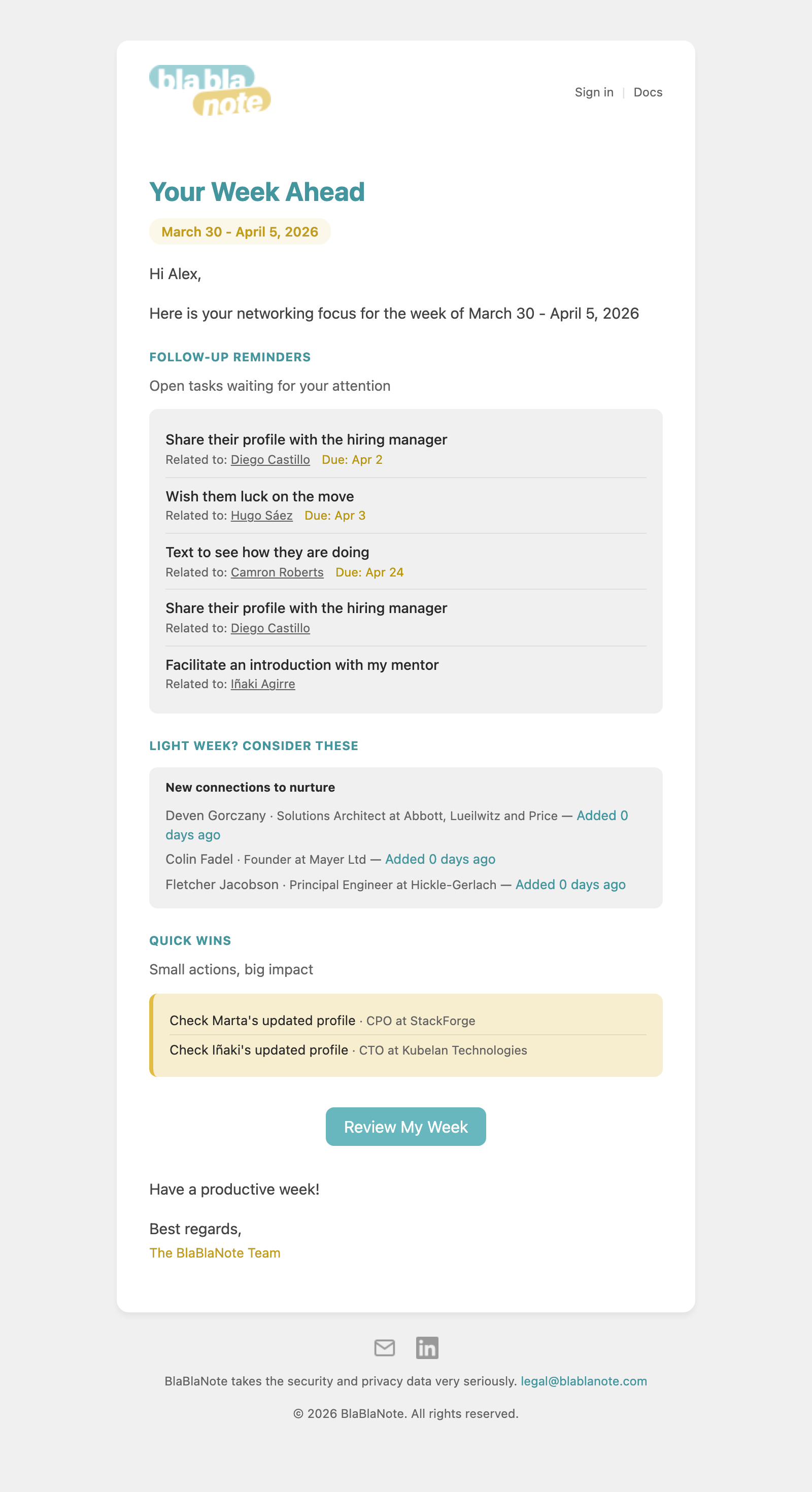
Every week, BlaBlaNote sends you a personalized briefing. Not a generic “here’s your calendar” notification, but an actual overview of your week built from your data. Here’s what’s inside:
Upcoming meetings with context
Your calendar events are listed with something most calendar apps don’t provide: the history behind each meeting. Not just “Meeting with Sarah, Wednesday 10am,” but the relationship context that helps you show up prepared. When you last spoke to Sarah, what you discussed, any open commitments, and what’s changed since then.
This is powered by the same intelligence that drives meeting preparations. The weekly email gives you the overview. If you want the deep briefing for a specific meeting, that’s available too. But for Monday morning planning, the summary version is what you need: a quick scan that tells you which meetings need preparation and which you’re already ready for.
Priority reconnections
These are contacts you haven’t reached out to in a while but who are strategically important to your networking goals. The AI doesn’t just flag people based on time since last contact. It weighs the importance of the relationship, the strength of your connection, and whether there’s a natural reason to reach out.
For example, if a key client posted about a company milestone on LinkedIn last week, that’s a natural reconnection opportunity. If a former colleague just changed roles, that’s worth a congratulatory message. The weekly email surfaces these moments so you can act on them while they’re still timely.
Follow-up reminders
Every conversation generates implicit and explicit commitments. “I’ll send you that proposal by Friday.” “Let me check with my team and get back to you.” “We should grab coffee next month.” BlaBlaNote tracks these through task extraction and surfaces the ones that are due or overdue in your weekly email.
This is where the weekly email saves relationships. A forgotten follow-up isn’t just a missed task. It’s a signal to the other person that the relationship isn’t a priority. When the weekly email reminds you that you promised Sarah a revised proposal three weeks ago, that’s not just a productivity nudge. It’s a relationship rescue.
Dormant connections worth reviving
Beyond your priority reconnections, the AI identifies connections that have gone quiet but still have potential. Maybe it’s someone you had a great conversation with at a conference six months ago but never followed up with. Maybe it’s a former client who might need your services again. The weekly email suggests these reconnections with context on why the relationship might be worth reviving.
Quick wins
Small actions with outsized impact. A birthday message for a key contact (powered by the same data behind never forgetting a birthday). A congratulations note for a promotion. A simple check-in that takes 30 seconds to send but keeps a relationship warm. The weekly email bundles these together so you can knock them out in a few minutes.
Context changes everything
The difference between “Meeting with Sarah, Wednesday 10am” and “Meeting with Sarah, Wednesday 10am, last time you discussed the partnership proposal, she’s waiting for your revised pricing, you haven’t spoken in 3 weeks” is the difference between showing up and showing up prepared.
BlaBlaNote’s weekly email does the second one. It connects your calendar to your contact history and tells you what actually matters about each event. Not just that it exists, but why it matters and what you should do about it.
How context is built
The context in your weekly email doesn’t come from a single source. It’s assembled from everything BlaBlaNote knows:
- Voice notes and recordings. Every voice note you’ve recorded and every call you’ve captured contributes to the relationship history. The AI summarizes relevant past conversations so you don’t have to go back and listen.
- Extracted tasks. Any action items pulled from conversations are cross-referenced with your calendar. If a task is due before a meeting with the same person, the email connects the dots.
- WhatsApp and Telegram messages. If you use BlaBlaNote to capture messages from these platforms, that context feeds into the weekly email too. A WhatsApp exchange with a client last Tuesday is relevant context for your meeting with them on Wednesday.
- Contact notes and tags. Manual notes you’ve added and tags you’ve applied to contacts add another layer of intelligence.
- Networking strategy. Your defined goals help the AI prioritize which relationships to highlight and what actions to recommend.
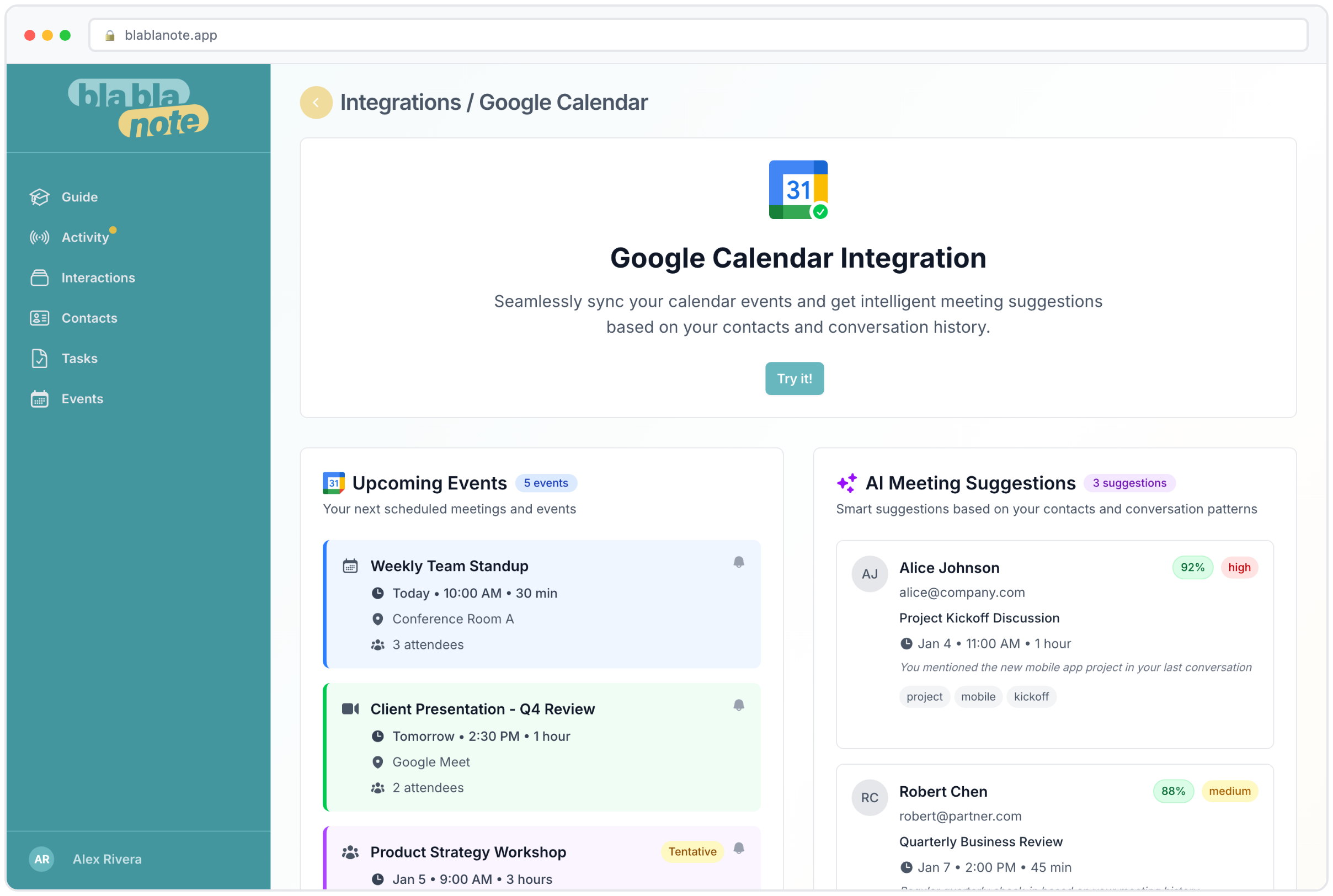
The result is a briefing that knows more about your week than you do, because it’s done the work of pulling together information you’d otherwise have to gather from half a dozen sources.
A typical Monday with the weekly email
Let’s walk through what this looks like in practice. It’s Monday morning, and the email arrives before your first coffee.
You scan the meeting section. Three meetings this week. The first is with a long-time client. The email notes you last spoke two weeks ago, you discussed expanding the engagement to a new department, and you promised to send a scope document. You haven’t sent it yet. That’s your first priority: get the scope document out before Wednesday’s meeting.
You review the reconnections. The email suggests reaching out to two contacts. One is a former client whose company just announced a new product line, a natural reason to send a congratulations message and check in. The other is a conference contact you met three months ago who works in a sector you’re trying to break into. You open their contact profile and decide a LinkedIn message is the right move.
You check the follow-ups. Two items are flagged. You promised an introduction between two contacts last week and forgot. And a prospect you pitched a month ago asked you to follow up “in a few weeks.” Both are easy actions that take five minutes each.
You glance at the quick wins. A key contact has a birthday on Thursday. The email reminds you. You set a reminder to send a personal message that morning.
Total time spent: ten minutes. But in those ten minutes, you’ve prevented a missed commitment before an important meeting, identified two reconnection opportunities, cleared two overdue follow-ups, and set yourself up for a relationship-strengthening birthday message. That’s the value of context delivered at the right time.
For managers and team leads
For managers overseeing a team, the weekly email is also a way to stay connected to what’s happening across client relationships without micromanaging. The weekly overview shows where attention is needed without requiring status meetings or manual check-ins.
Each team member receives their own personalized weekly email. A sales rep gets a briefing focused on prospects and pipeline follow-ups. An account manager gets a briefing focused on client health and renewal conversations. A team lead gets a briefing that surfaces their own meetings plus any cross-team coordination items.
The result is that everyone starts Monday with the same quality of preparation, regardless of how organized they are individually. The team that uses BlaBlaNote’s weekly email isn’t relying on individual memory or discipline to maintain relationships. The system does the remembering.
It works in your language
The email arrives in whichever language you prefer. English, Spanish, French, or any of BlaBlaNote’s supported languages. All the context, all the suggestions, fully localized. For international teams or professionals who work across markets, this means everyone gets the same quality of briefing in the language they think in.
This isn’t just about interface language. The AI-generated summaries and suggestions are produced in your chosen language. If you work in French, your meeting context is in French. If your custom vocabulary includes French technical terms, those appear correctly in the weekly email too.
Making the most of your weekly email
Read it before you open your calendar. The email is designed to give you the context your calendar doesn’t. If you read your calendar first, you might start your day with incomplete information.
Act on the quick wins immediately. Birthday messages, congratulations notes, and simple check-ins take 30 seconds each. Do them while the email is open. The compounding value of consistent small gestures is enormous.
Use reconnections as conversation starters. The AI suggests reconnections for a reason. Don’t just send “Hey, it’s been a while.” Use the context provided. “I saw your company’s new product launch, congratulations! Last time we spoke, you mentioned expanding into the European market. How’s that going?”
Flag overdue follow-ups as urgent. If the email surfaces a commitment you’ve missed, don’t let it slide another week. A late follow-up is better than no follow-up, and acknowledging the delay honestly (“Apologies for the delay, this should have come sooner”) is always better than pretending it didn’t happen.
The point
We wanted planning your week to feel like something that happens to you, not something you have to do. The AI already knows your schedule, your contacts, your open tasks, your pending follow-ups. It just needed to put it all together and deliver it at the right time.
Now it does. Before your first coffee. And for the business, it means fewer things fall through the cracks, follow-ups happen on time, and client relationships get the attention they deserve, starting from the very first day of the week.
The weekly planning email isn’t a to-do list. It’s a strategic briefing for your professional relationships. It’s the difference between a Monday that starts with “what do I need to do this week?” and one that starts with “here’s what matters and here’s why.” That shift, from reactive to proactive, is where relationships get stronger and opportunities stop slipping away.