Personal CRM for Freelancers: How to Manage Clients and Grow Your Network

- Why freelancers need a personal CRM (not Salesforce)
- What freelancers actually need from a CRM
- Track conversations and context per client
- Follow-up reminders that actually work
- Quick capture after calls and meetings
- See the big picture
- The freelancer’s workflow with BlaBlaNote
- Morning: review your week
- During the day: capture as you go
- End of day: tasks are already organized
- Managing the feast-or-famine cycle
- The referral multiplier
- From freelancer to small agency
- Getting started as a freelancer
- The freelancer’s unfair advantage
Freelancing is a relationship business disguised as a skills business. You got into it because you’re great at design, development, consulting, writing, coaching, or photography. But staying in it, and thriving, depends on something nobody teaches you: managing the web of relationships that keeps work coming through the door.
If you’ve been freelancing for more than a year, you know the pattern. A client mentions they might need help next quarter. You make a mental note. Two months later, you can’t remember if it was Q2 or Q3, or whether they wanted the same scope as last time or something different. Meanwhile, a past client you haven’t spoken to in six months just hired someone else for a project you would have been perfect for. They didn’t think of you because you weren’t on their radar anymore.
This isn’t a skills problem. It’s a systems problem. And it’s exactly the kind of problem a personal CRM solves.
Why freelancers need a personal CRM (not Salesforce)
Let’s get this out of the way: enterprise CRMs aren’t built for you. Salesforce, HubSpot, Pipedrive: these are designed for sales teams with dedicated account managers, pipeline stages, and quarterly targets. They assume you’ve got a structured sales process, a marketing team generating leads, and a manager reviewing your pipeline. As a freelancer, you are the sales team, the account manager, the delivery team, and the marketing department. All at once.
What you need isn’t a pipeline tool. You need a way to remember what matters about the people you work with and the people who might hire you next.
The real pipeline for most freelancers isn’t a sales funnel. It’s a network. Studies keep showing that most freelance work comes through referrals, repeat clients, and warm introductions. The person you had coffee with six months ago mentions your name to a colleague. The client whose project you finished last year comes back with a bigger budget. The contact you met at a conference introduces you to their team lead. These aren’t cold leads moving through a funnel. They’re relationships that need nurturing.
The problem is that most freelancers manage these relationships with a combination of email threads, WhatsApp messages, scattered notes, calendar entries, and memory. The information exists, but it’s spread across a dozen places. When you need to remember what you discussed with a prospect three weeks ago, you’re scrolling through messages and trying to piece together the context. When you want to check in with past clients you haven’t talked to in a while, you have no easy way to see who’s been dormant.
A personal CRM puts all of that in one place. Not as a heavyweight database you have to maintain, but as a living record of your professional relationships that builds itself as you go about your work.
What freelancers actually need from a CRM
After watching how hundreds of freelancers and independent professionals use BlaBlaNote, we’ve noticed the features that matter most aren’t the ones you’d see on an enterprise CRM feature chart. They’re way simpler, and way more practical.
Track conversations and context per client
Every client relationship has a history. The initial discovery call where they explained their challenges. The follow-up where you discussed scope and timeline. The mid-project check-in where they shifted priorities. The wrap-up where they mentioned a possible Phase 2.
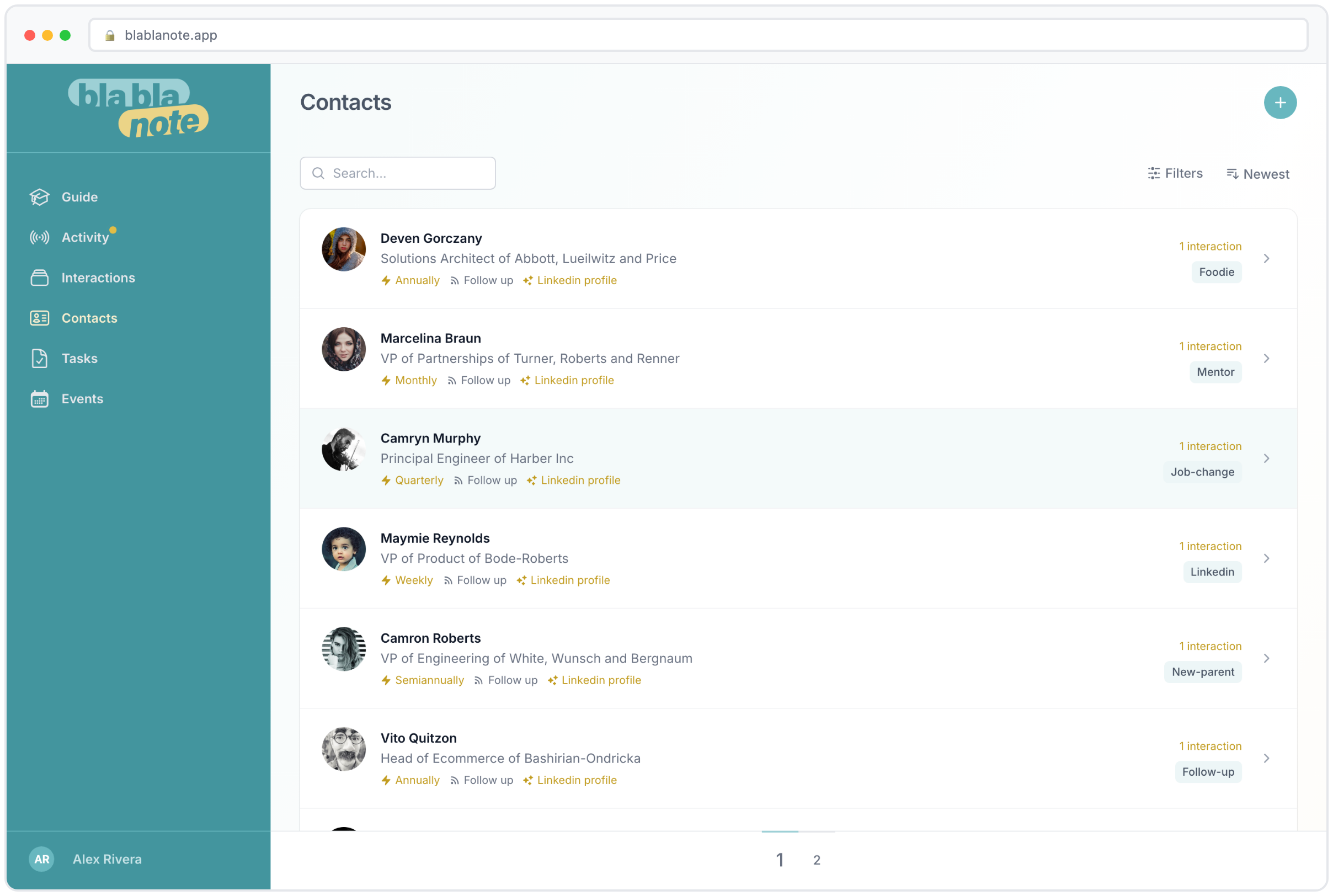
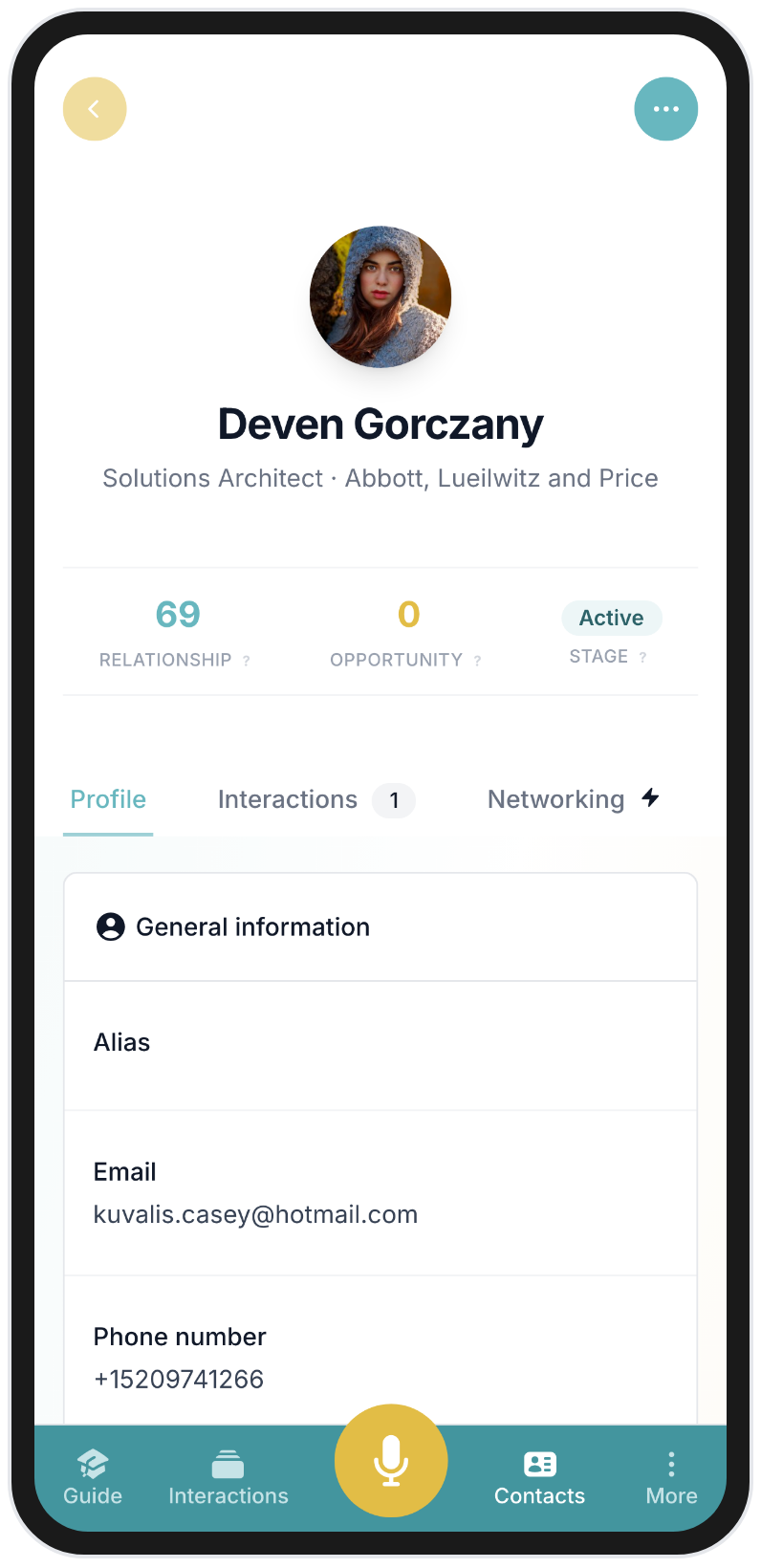
When that history lives in your memory, it fades. When it lives in email threads, it’s buried. When it lives in a contact profile with linked notes, summaries, and extracted action items, it’s accessible in seconds. The next time a client calls, you open their profile and the entire relationship is there: what you discussed, what you promised, what they care about, and what’s still pending.
This is especially valuable when you’re juggling multiple clients at once. When you’re bouncing between five different projects in a week, the mental load of remembering the specifics of each relationship is huge. A CRM that tracks context per client takes that burden off your plate entirely.
Follow-up reminders that actually work
The single most valuable habit you can build as a freelancer is consistent follow-up. Not pushy sales follow-up, but genuine, relationship-maintaining follow-up. “Hey, how did that product launch go?” “I saw your company just announced the expansion, congratulations.” “It’s been a few months since we wrapped up the project. How’s the team doing?”
These touchpoints keep you top of mind. But they only happen if you have a system that surfaces them. BlaBlaNote’s weekly planning email shows you which contacts you haven’t engaged with recently, upcoming meetings that need preparation, and overdue follow-ups. It’s like having a personal assistant who taps you on the shoulder every Monday morning and says, “Here are the five people you should reach out to this week.”
Quick capture after calls and meetings
Freelancers spend their days in conversations. Client calls, prospect meetings, networking coffees, project kick-offs. The “proper” approach is to open a document after each one and type up notes. In reality? You’re already running to the next thing, and the notes never get written.
Voice notes change this completely. You finish a call, hit record, and spend 60 seconds talking through what was discussed. The AI transcribes it, extracts the key points, pulls out any action items, and links everything to the relevant contact. Sixty seconds of talking replaces ten minutes of typing you were never going to do anyway.
See the big picture
When your client relationships are tracked in one place, you can see patterns. Who haven’t you spoken to in three months? Which prospects showed interest but never converted, and is it time to circle back? Which past clients might have new needs based on what they told you six months ago?
This bird’s-eye view is something freelancers almost never have. You’re so deep in delivery mode that relationship management runs on autopilot, which usually means it barely runs at all. A personal CRM gives you the dashboard you need to manage your network with intention instead of guesswork.
The freelancer’s workflow with BlaBlaNote
Let’s walk through what a typical day looks like when you’re using BlaBlaNote as your personal CRM.
Morning: review your week
You open your weekly planning email. It shows you that you have a client call at 10 AM (with a briefing based on your last three interactions with them), a prospect meeting at 2 PM (with context from the networking event where you first met), and a reminder that you haven’t spoken to two past clients in over 90 days. You make a mental note to send them a message this afternoon.
Before the 10 AM call, you glance at the meeting briefing. It shows the summary from your last conversation: they were considering expanding the project scope to include a mobile app, they mentioned a budget review happening in March, and you promised to send case studies of similar work. You sent the case studies (there’s a task marked as completed), so you’re going in prepared.
During the day: capture as you go
The 10 AM call goes well. They want to move forward with the expanded scope. When you hang up, you hit record on BlaBlaNote and spend 45 seconds recapping: the expanded scope is confirmed, they want a proposal by next Friday, the budget is around 15K, and they want to start in May. The AI transcribes this, links it to the client’s contact profile, and extracts two tasks: draft the proposal and schedule a follow-up for next Wednesday.
At 2 PM, your prospect meeting happens over coffee. Afterward, you use the call-to-capture feature while walking back to your car. You dial the number and talk for a minute about who the prospect is, what they need, the timeline they mentioned, and the fact that they’re also talking to another freelancer. By the time you’re driving, the note is already processed and linked to the contact.
Between meetings, a client sends you a voice message on WhatsApp with feedback on a deliverable. You forward it to BlaBlaNote. It becomes a searchable note linked to their contact, with the key points extracted. No more scrolling through WhatsApp trying to find that one message from last Tuesday.
End of day: tasks are already organized
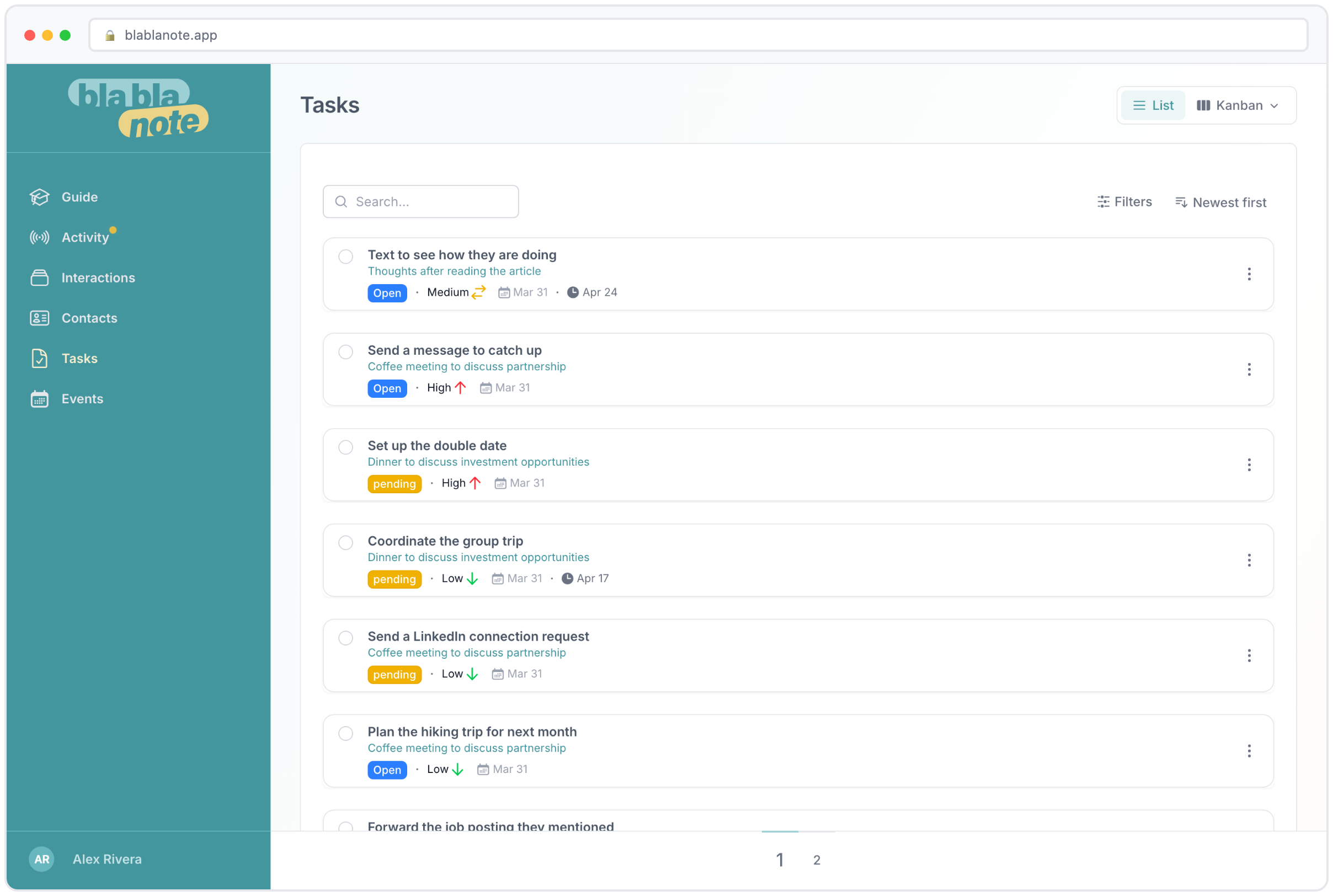
You open BlaBlaNote and your task list is populated with everything that came up during the day. Draft the proposal. Schedule the follow-up. Respond to the WhatsApp feedback. Reach out to the two dormant past clients. You didn’t have to write any of this down manually. It was all extracted from your voice notes and messages throughout the day.
Managing the feast-or-famine cycle
Every freelancer knows it. You’re drowning in work for two months, then suddenly the pipeline is empty. The feast-or-famine cycle is the defining challenge of freelance life, and the root cause is almost always the same: when you’re busy with delivery, you stop doing the relationship nurturing that brings in new work.
A personal CRM won’t eliminate this cycle completely, but it smooths it out dramatically. Here’s why.
When you’re in feast mode, with multiple active projects and back-to-back deadlines, the CRM keeps your relationship maintenance on autopilot. The weekly email still surfaces the contacts you should reach out to. The follow-up reminders still fire. Even if all you do is send a quick “thinking of you, hope the launch went well” message to a past client, you’re staying visible. That two-minute interaction, multiplied across your network over weeks and months, is what keeps the referral engine running even when you’re too busy to actively seek new work.
The key is setting networking goals that reflect your current phase. In a delivery-heavy period, your goal might be simply to maintain existing relationships with minimal effort. In a quieter period, you might shift to actively expanding your network. BlaBlaNote’s AI adjusts its recommendations accordingly, so you’re always working the relationships that matter most for where you are right now.
The freelancers who escape the feast-or-famine cycle are the ones who treat relationship building as an ongoing background process, not something you do only when you need work. A personal CRM makes that possible without eating up a lot of your time.
The referral multiplier
Here’s something most freelancers don’t realize: the compound effect of consistent follow-up. When you stay in touch with 50 past clients and contacts, and each of them occasionally thinks of you when someone asks “do you know a good designer/developer/consultant?”, that’s a referral network working for you 24/7. But it only works if those 50 people actually remember who you are and what you do. The CRM-powered follow-up ensures they do.
One freelancer we spoke to tracked their revenue sources after implementing a systematic follow-up routine with BlaBlaNote. Within six months, referrals went from about 30% of new business to over 60%. Nothing changed about their skills or their marketing. The only difference was that past clients and contacts heard from them regularly enough to keep them top of mind.
From freelancer to small agency
Many freelancers eventually hit a point where they start bringing on collaborators, subcontractors, or even employees. Going from solo freelancer to small agency brings new relationship management challenges. Suddenly you’re not just tracking clients. You’re also coordinating team members, managing subcontractor relationships, and ensuring that client knowledge doesn’t live solely in your head.
A personal CRM that grows with you makes this transition way smoother. The contact profiles, conversation histories, and task extractions you’ve been building become a shared knowledge base. When you bring someone onto a project, they can see the full history of the client relationship. When you’re reviewing a team member’s work, you have context on what the client actually asked for.
BlaBlaNote’s coaching solution is particularly relevant here. If you’re mentoring junior freelancers or managing a small team, the structured note-taking and insight generation help you track each person’s development, capture coaching conversations, and maintain the kind of personalized attention that gets lost when you’re scaling.
Getting started as a freelancer
If you’re ready to stop relying on memory and start building a system for your freelance relationships, here’s how to get going with BlaBlaNote.
Import your existing contacts. If your network lives in Google Contacts, bring it over. If your professional connections are on LinkedIn, use the LinkedIn import to pull in your network with all the context that comes with it: job titles, companies, how you’re connected. This gives you a starting base instead of building from scratch.
Set up your capture routine. The most important habit to build is the post-conversation voice note. After every client call, prospect meeting, or networking conversation, spend 60 seconds recording what happened. This single habit will transform your relationship management within weeks. If clients communicate via WhatsApp or Telegram, set up the message forwarding so those conversations are captured automatically.
Create your digital business card. As a freelancer, first impressions matter. A digital business card that lives on your phone and can be shared instantly makes it easy for new contacts to save your information and remember who you are.
Review your weekly planning email. Every Monday, spend five minutes reading through the AI-generated summary of your week. Check who you should follow up with, review upcoming meetings, and identify any dormant relationships that need attention. Five minutes of planning translates into a week of intentional relationship building.
Set your networking goals. Tell BlaBlaNote what you’re working toward (finding new clients, building partnerships, expanding into a new market) and the AI tailors its recommendations to match. This is especially powerful when you’re attending events or conferences, where the smart event networking features help you identify the people who matter most for your current goals.
The freelancer’s unfair advantage
In a world where most freelancers compete on skills and price, the ones who build strong, well-maintained professional relationships have an unfair advantage. They get the call before the job is posted. They get the referral before the prospect starts Googling. They get the repeat engagement because the client remembers how easy they were to work with, and because the freelancer remembered every detail of what the client cares about.
A personal CRM isn’t some luxury tool for enterprise sales teams. For freelancers, it’s the infrastructure that turns good work into a sustainable business. The skills get you in the door. The relationships keep the doors open. And a system for managing those relationships ensures that nothing, and no one, falls through the cracks.
BlaBlaNote offers a free 30-day trial with full access to every feature. No credit card required. If you’re a freelancer who’s tired of letting good relationships fade because you didn’t have a system, this is where you start.