
- Why the notes never get written
- Capture, organize, nurture
- Presence during, context after
- Before: let the calendar do the introductions
- During: one click, then listen
- After: the interaction lands on the person
- Next week: nurture with context
- Recording with consciousness, not by default
- Why this matters most for the people you see least
- Starting with your next call
You know the moment. The call ends, the window closes, and the next one is already starting. Somewhere in the last forty minutes someone mentioned a person you should meet, a date that matters to them, a number you agreed on. You were there. You heard it. And by Thursday it will be gone.
It is not that you weren’t paying attention. It is that you were, and paying attention and writing things down are two different jobs.
Most professionals now spend a good part of their week in video calls: with clients, partners, candidates, people they met at an event and promised to follow up with. Each of those conversations is an interaction with a real person, and each one leaves something behind that could strengthen the relationship if it survived the week. Usually it doesn’t. Not because the conversation was unimportant, but because nothing in the way you work is built to keep it.
Why the notes never get written
Almost everyone has tried the obvious fixes. A notes app open in a second window. A notebook next to the keyboard. A promise to write it all up “right after”. Each one fails in the same place, and it is worth being precise about why.
Writing during the meeting splits you in two. Pam Mueller and Daniel Oppenheimer (2014) found that people taking notes on a laptop tend to transcribe rather than think, copying words instead of processing them. Later studies have debated how large that effect really is, but anyone who has typed through a video call knows the feeling: the moment you look down to capture what someone just said, you stop hearing what they are saying now. The nuance goes first. The tone of voice, the hesitation before a yes, the name dropped in passing that would have been the most useful thing in the whole call.
And the other person notices. A conversation where one side is visibly typing feels less like a conversation and more like an interview. People become shorter, more guarded, less likely to share the detail that turns a contact into a relationship.
Writing after the meeting runs into memory. Hermann Ebbinghaus (1885) measured how fast we forget, and the curve is steep: a large share of what you take in is gone within the first day unless you do something with it. The practical meaning is simple. If the summary is not written within the hour, what gets written later is a reconstruction, not a record. You remember that the call “went well”. You no longer remember why.
And the next meeting starts anyway. Back-to-back calendars leave no gap for “right after”. The notes app stays empty, not out of laziness, but because the method asked for time that the day never had.
None of this is a matter of willpower. The method asks for something the day cannot give. Any method that depends on you remembering to do something, while you are busy doing something else, will fail on exactly the days that matter most: the busy ones, the ones full of good conversations.
Capture, organize, nurture
Caring for a professional network rests on three moves: capture, organize and nurture. A single meeting tests all three at once, and dropping any one of them makes the other two worthless.
Capture is what happens in the moment. It has to start where you already are, with a single action, and ask nothing of you while the other person is talking. A capture method that needs discipline mid-conversation is a capture method that will be skipped.
Organize means attaching what was said to the right person. An audio file in a folder called “Recordings” is a record of an event. What you actually need is a record of a relationship: what this person told you, sitting next to everything else you know about them, so that three months from now you find it by thinking of them, not by guessing a file name.
Nurture is what the first two exist for. A transcript is raw material. The commitments, the follow-ups, the small personal details: that is what you reach for when it is time to write to someone again, and it is what makes the message sound like you actually remember them.
Most tools cover one of the three. A recorder captures but leaves you with a folder of audio you will never open. A CRM organizes, but only what you type into it, which leads straight back to the notes nobody has time to write. A reminder app nudges you to reconnect, but gives you nothing to say when you do.
Robert Waldinger and Marc Schulz (2023), who lead the Harvard Study of Adult Development, call the habit of tending relationships social fitness: relationships, like muscles, weaken when they are not exercised, and strengthen with small, regular attention. The interesting word there is regular. A good meeting is a single workout. What keeps the relationship strong is what you do with it in the weeks that follow, and that depends almost entirely on whether you still know what was said.
Presence during, context after
Here is what a meeting looks like when the three pieces work together. None of it requires more effort than you spend today. Most of it requires less.
Before: let the calendar do the introductions
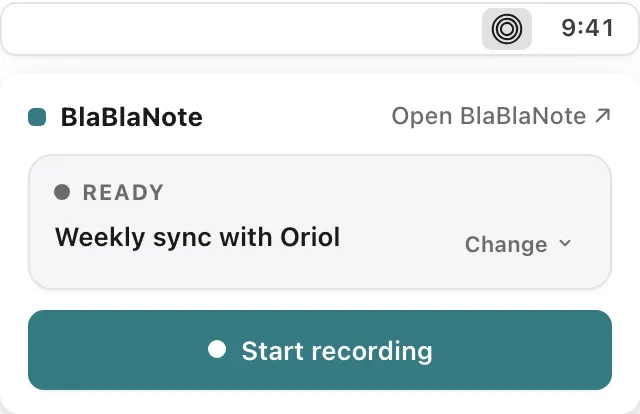
Your calendar already knows who you are meeting and when. That is the starting point for everything else, and it should not be typed a second time.
This is where BlaBlaNote Recorder comes in: a small desktop app for macOS and Windows that lives in your menu bar, next to the clock. When you open it at the start of a call, it has already found the event that is running and knows who is on the invite. If two events overlap, it asks which one you are in instead of guessing. If there is nothing in the calendar, you can still record, because a spontaneous call with an old colleague is still a conversation worth keeping.
During: one click, then listen
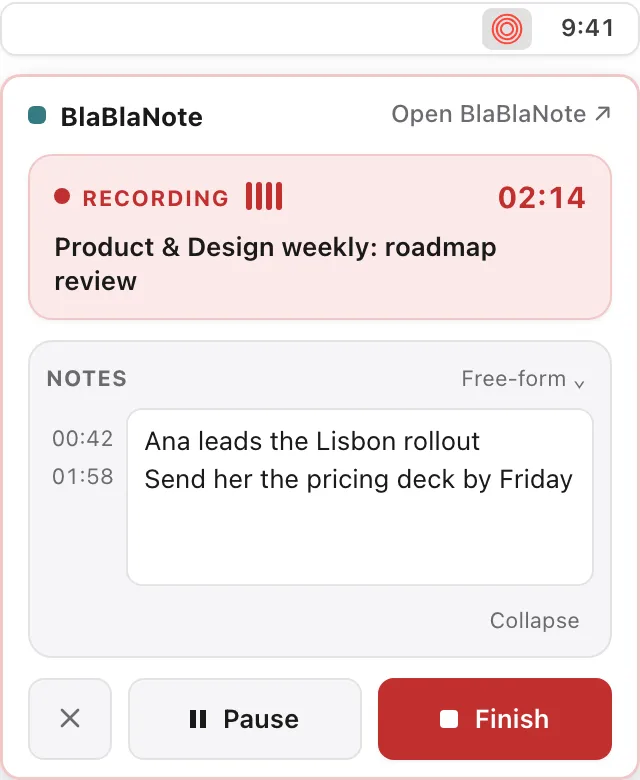
Start recording with one click, and then do the thing the whole method exists for: listen. The recorder captures both sides of the call, what comes through your speakers and what you say into your microphone. You can pause it when the conversation drifts into something that should not be kept, and discard the recording entirely if it turns out it should never have been made. Its icon turns red while it is recording, so you never have to wonder, and then you can forget it is there.
Tell the people in the meeting that you are recording. It is the right thing to do, and in many places it is what the law requires. It also tends to change the conversation for the better. People are more precise when they know the details will be kept, and more relaxed when they know why. “I’m recording this so I can listen instead of taking notes” is a sentence very few people object to, and many appreciate.
Relationships are built on trust. A recording made without the other person’s knowledge undermines the very thing it is meant to help.
After: the interaction lands on the person
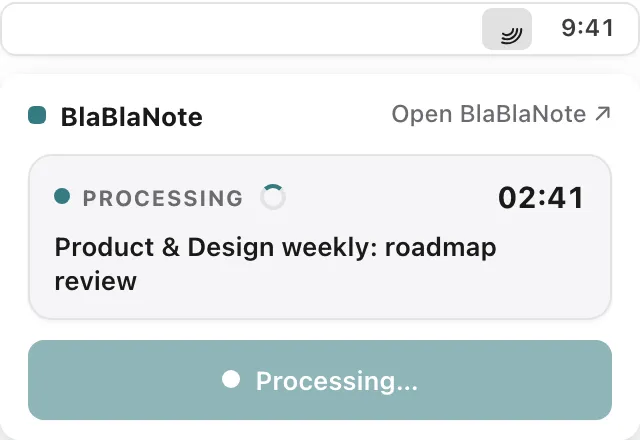
When the call ends, you click finish and walk away. The last of the audio uploads on its own. The transcript and the summary appear on the interaction, hung off the people who were in the meeting: not in a downloads folder, but on their contact, next to the voice note you left after a coffee last spring and the follow-up you promised in June.
That is the organize step done without you doing it. The audio is encrypted, transcribed on Amazon Web Services inside the European Union and, once transcribed, deleted one day after it is received. We do not use it to train models, and neither does Amazon Web Services, because we turned on its opt-out.
Next week: nurture with context
Now the part that actually builds relational capital. Within a couple of days, go back to the interaction and look for three things:
- The commitment. Anything you promised: an introduction, a document, a date. Turn it into a task while it is fresh.
- The ask behind the ask. What were they actually trying to solve? Often it is not what they opened the meeting with.
- The human detail. The trip they are about to take, the project they are proud of, the child who just started university. The detail you would never have written down while they were talking, and the one that matters most the next time you write.
A two-line message a week later that picks up one of those threads does more for the relationship than a long meeting ever could. It tells the other person that the conversation mattered enough to be remembered.
Recording with consciousness, not by default
A tool that makes recording effortless also makes it easy to record everything, and that is not the goal. Networking with intent means choosing.
Some conversations are better left unrecorded. A first call where someone is deciding whether to trust you. A difficult conversation about a mistake. A moment when a colleague is telling you something personal because they need to say it, not because they want it filed. In those cases the most valuable thing you can offer is your full, unrecorded attention, and a short voice note to yourself afterwards with what you want to remember.
A useful rule of thumb: record when the details will matter later and the other person would be glad you kept them. Commitments, introductions, plans, numbers. Leave the recorder off when the value of the conversation is the conversation itself.
The same judgement applies after the call. Not every interaction needs a follow-up, and not every contact needs the same rhythm. Some relationships want a message every few weeks; others are perfectly healthy with a note twice a year. What matters is that the choice is yours, made with the context in front of you, rather than made for you by whatever you happened to forget.
Why this matters most for the people you see least
It is tempting to think this is about your most important meetings: the big client, the investor, the partner. Those are the conversations you are least likely to forget.
The ones you lose are the others. The call with someone you met at a conference and promised to follow up with. The coffee chat with a former colleague who has just changed jobs. The introduction a friend made that you took out of politeness and that turned out to be interesting.
Mark Granovetter (1973) showed that these weak ties, acquaintances rather than close friends, are the ones most likely to bring new opportunities, precisely because they move in circles different from yours. They are also the relationships where context disappears first, because you talk to them rarely and remember them vaguely. When you do reconnect a year later, the difference between a message that sounds like you remember them and one that sounds like a template is almost always one or two details from the last conversation.
Relational networking is not about meeting more people. It is about doing justice to the conversations you are already having. Your calendar is full of them.
Starting with your next call
You do not need a new routine. You need one small change at the start of the meetings you already have.
If a good part of your week happens in video calls, download the recorder and use it on the next conversation that matters. It is included in the Pro plan, and every account gets it for its first 30 days. Don’t change anything else about how you work: click once at the start, tell the others you are recording, listen properly, and look at what is waiting for you on their contact afterwards.
Then try the harder part: write to one of those people next week, using something they told you.
The meetings are already in your calendar. The people are already in your network. What is left to decide is how much of what they tell you will still be there when it is time to talk again.
